/)
/)
/)
/)
/)
/)
/)
/)
/)
/)
/)
/)
/)
/)
/)
/)
/)
/)
/)
/)
/)

optibelt TN
Configure your product
Description
Use of Taper-Hubs for force-fit shaft-hub connections
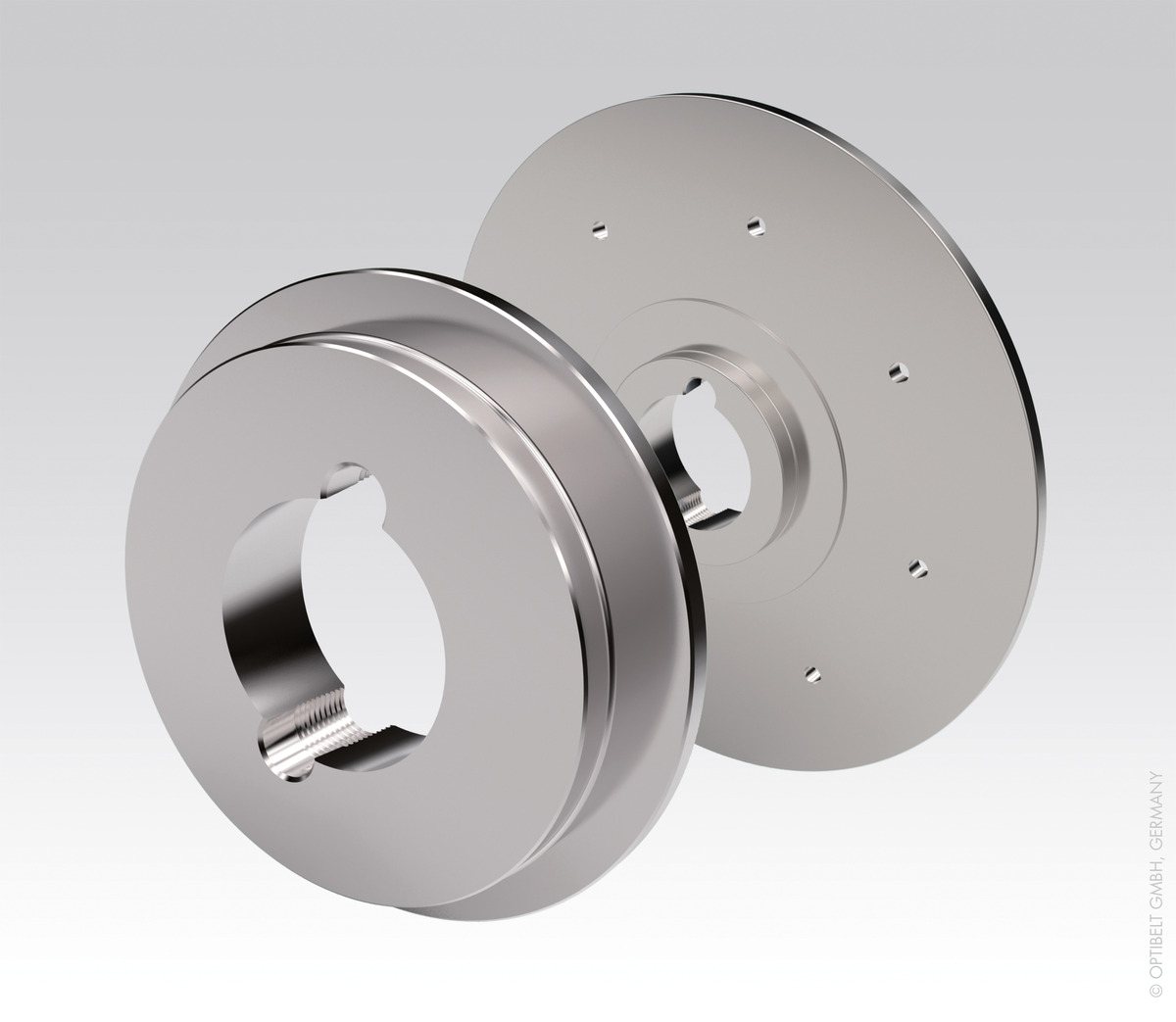
Taper-Hubs are machine elements used in mechanical engineering to create force-fit connections between shafts and hubs. There are two different types of fastening: bolt-on or weld-on. In both cases, the Taper-Hubs are already prepared with a conical inner receptacle for the installation of standard Taper-Bushings. The Taper-Bushing system offers a simple, cost-effective, and flexible variant of the shaft-hub connection.
Taper bolt-on Hubs - ideal for air conditioning and ventilation technology
Taper bolt-on Hubs are universally applicable and are mainly used in air conditioning and ventilation technology but are also used in general mechanical engineering.
Optibelt Taper bolt-on Hubs offer a cost-effective solution for quickly and easily mounting and removing rotating parts, such as fans or fan wheels, onto a shaft. They are mainly used in places where welding is not possible. The components to be mounted can be mounted on the bolt-on hubs on both the right and left sides using a centering device. To do this, the rotor simply needs to be provided with mounting holes for the screws. The recommended tolerance is H8. The possible mounting circles range from Ø 100 mm to Ø 340 mm. Screws and nuts are not included in the scope of delivery. Our standard designs are available for Taper-Bushings in sizes 1210 to 3020. All standard Taper-Hubs are supplied unbalanced. Taper-Bushings must be ordered separately.
Taper weld-on Hubs for demanding operating conditions
Our Optibelt Taper weld-on Hubs are equipped with a protruding flange. This provides a convenient way to weld the Taper-Hub into fans, fan wheels, steel pulleys, sprocket pulleys, and other devices that need to be firmly mounted on a shaft. Taper weld-on Hubs are particularly suitable for use in difficult conditions. They are mainly used in steel and welded constructions, in air conditioning and ventilation technology, and in conveyor technology, for example with belt drums or sprocket pulleys. In addition, they can also be used in general mechanical engineering.
Weld-on Hubs are available with a centering diameter of 60 mm to 242 mm. To avoid heat distortion, it is recommended to mount a Taper-Bushing with a piece of shaft in the weld-on Hub before welding.
Our standard designs are available for Taper-Bushings in sizes 1210 to 5050. All standard Taper-Hubs are supplied unbalanced. Taper-Bushings must be ordered separately.
In addition to our standard range, we are happy to offer custom-made products according to individual specifications on request.
We reserve to alter specifications without notice.
Details
Passende Produktlösungen

/)
Services & Tools
/)