/)
/)
/)
/)
/)
/)
/)
/)
/)
/)
/)
/)
/)
/)
/)
/)
/)
/)
/)
/)
/)





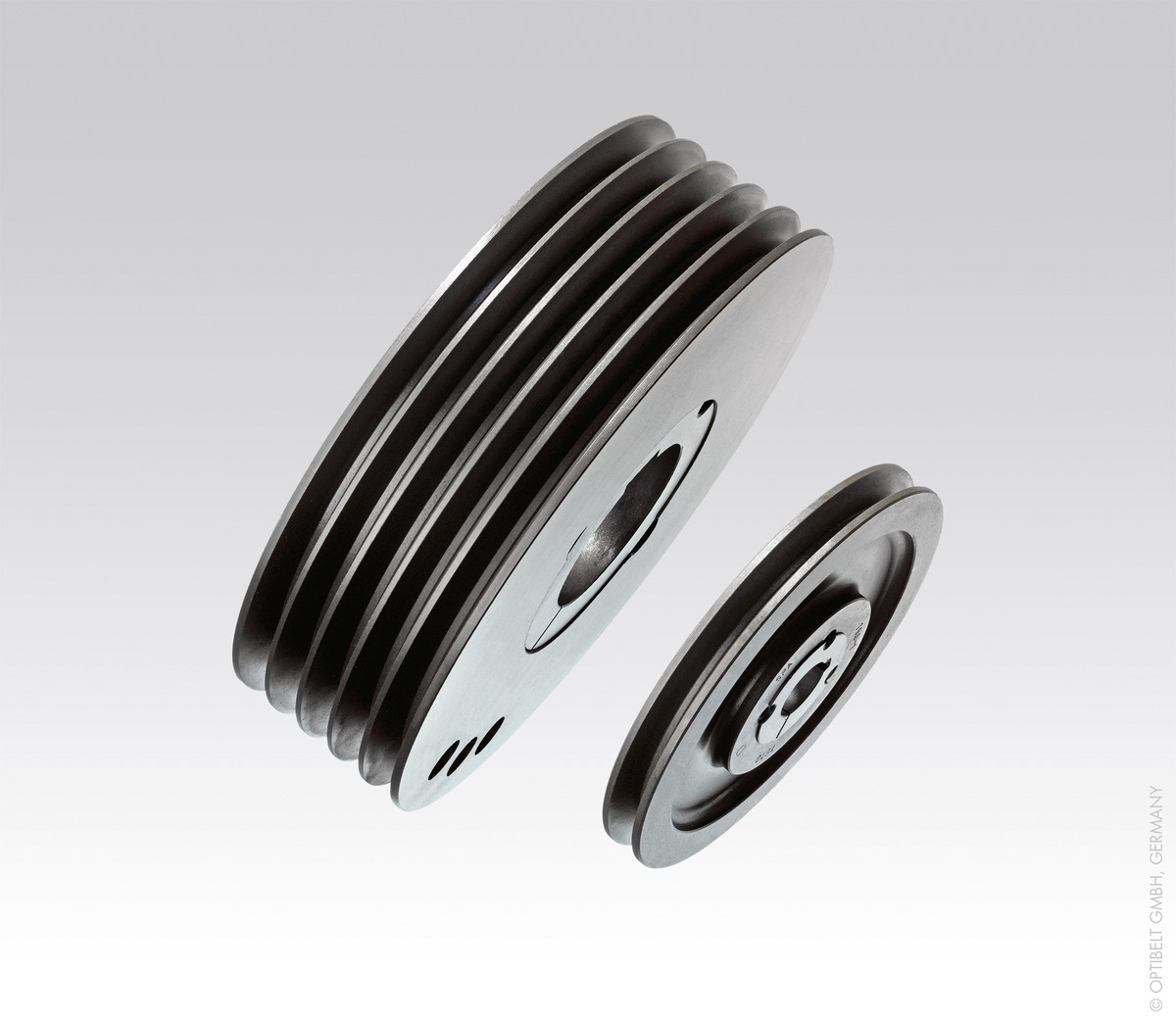
optibelt KS for Taper-Bushings
Configure your product
Description
V-grooved pulleys in Use: Function and Characteristics
V-grooved pulleys are a central component of a V-belt drive. They are used to connect two shafts. Power is transmitted via static friction - also known as adhesion - between the flanks of the V-belt and the pulleys, thereby creating a force connection.
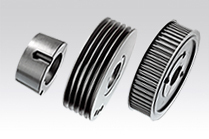
V-grooved pulleys, also known as wedge pulleys, feature one or more grooves in which the V-belts are securely guided. The profile of the V-grooved pulley is precisely matched to the respective belt profile. The number of grooves depends on the number of V-belts required.
V-grooved pulleys in operation: Power, transmission ratio, and application
Optibelt KS V-grooved pulleys offer a wide range of applications due to their transferable power and permissible speeds. In positive V-belt drives, transmission ratios of up to i = 1:12 can be achieved. Typically, such a drive consists of a drive pulley and a driven pulley. Due to the friction-based power transmission, there is always a small amount of slip, which means that in practice, the speed of the driven pulley is approximately 1% lower. Optibelt recommends friction-based V-belt drives especially for non-synchronous power transmissions. They are characterized by high cost-effectiveness, reliability, and - compared to timing belts - a long service life.
Friction-based power transmission using optibelt V-belts and KS V-grooved pulleys is particularly well-suited for power drives. The following applies: The larger the belt profile, the higher the transmissible power. Another area of application is conveyor drives. V-belts are not suitable for linear drives. In such cases, positive-engagement power transmission using optibelt timing belts and ZRS timing pulleys should be used.
We reserve to alter specifications without notice.
Details
Efficient power transmission
Advantages of V-Belt Drives
Suitable Product Solutions

/)
/)
/)
Design and Function of the V-Grooved Pulley
Services & Tools
/)