Add to shopping list

optibelt ZRS DC for Taper-Bushings

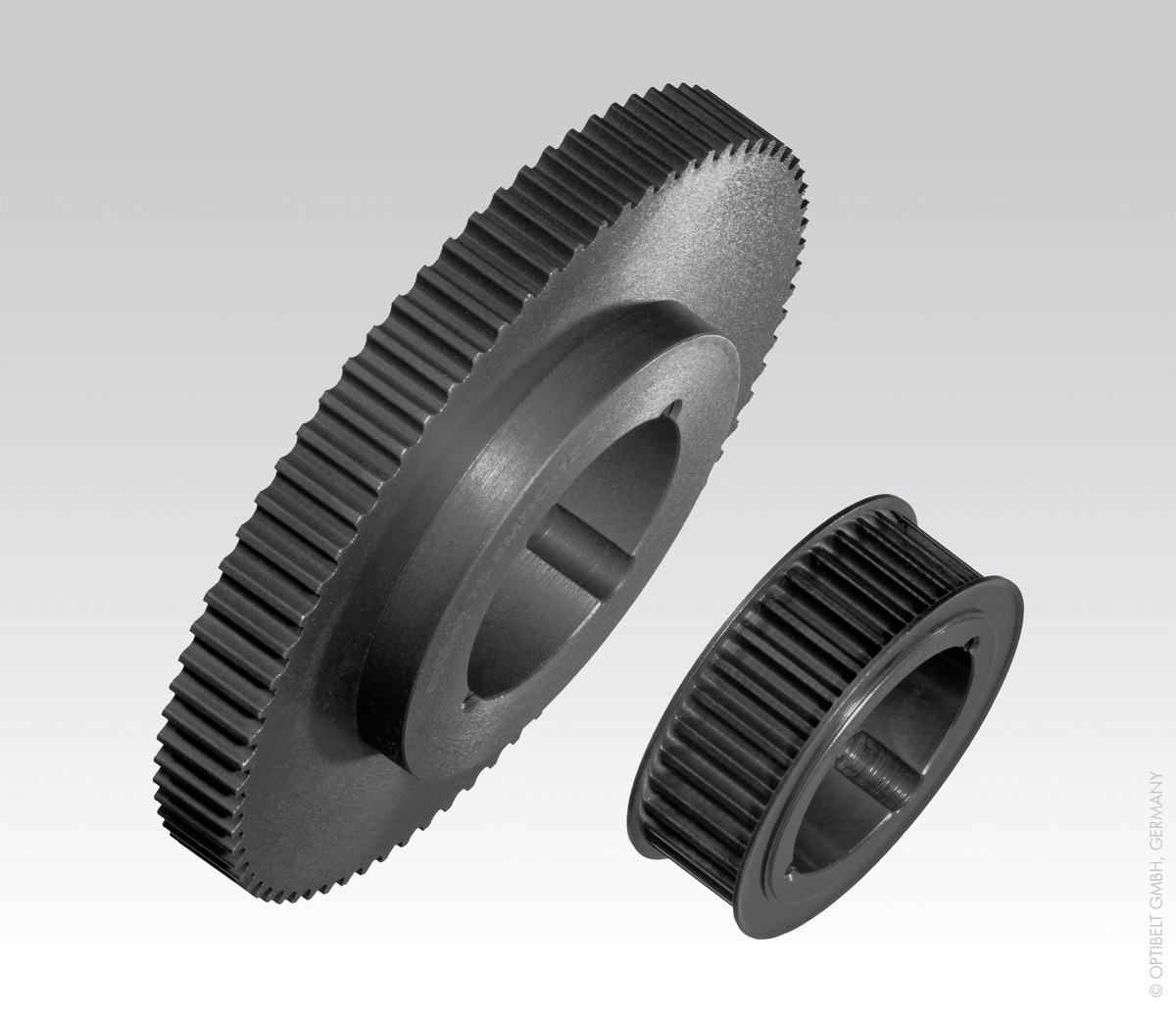
ZRS DC Timing Belt Pulleys for Taper-Bushings - Profile acc. to ISO 13050

Configure your product

Profile
Product description
Number of teeth
For belt width (mm)
Diameter (outside) (mm)
Quantity
Select a variant to view the prices and availability.

Description

High quality

Our high-quality DELTA CHAIN timing belt pulleys are manufactured in accordance with ISO 13050, DIN/ISO 5294 or ISO 17396 from steel, cast iron EN-GJL-200 (old GG-20) or aluminum and are available for cylindrical bores and for taper bushings.


Standard sizes

The taper clamping bush system offers a simple, cost-effective and flexible variant of the shaft-hub connection. Thanks to the internationally standardized sizes of the taper bushes, changes to the bore diameter can be implemented quickly and easily from stock.


Positive fit

The timing belt pulleys transmit the torque positively. This makes it possible to transmit comparatively high torques - even at high speeds - without slippage. Reduction ratios of up to 1:8 can be achieved with pulleys of different sizes.

Details

DOWNLOADS

At a glance

Advantages of form-fit drive systems

Compact and space-saving design

Small minimum pulley diameters, high flexibility, and narrow shaft spacing allow for high gear ratios while requiring minimal installation space.

Reliable Power Transmission Without Slip

The form-fit power transmission operates reliably even when the coefficient of friction between the belt and pulley is reduced. The absence of slip also enables a high efficiency of up to 98%.

Economic Design of Drive Components

The low preload forces reduce the stress on shafts and bearings. As a result, bearings and shafts can be designed to be smaller and more cost-effective.

High Performance with Minimal Maintenance

The low weight of the Timing Belts allows for high belt and circumferential speeds. At the same time, form-fit drives operate with mostly no maintenance.

Suitable Product Solutions

Divider

These products perfectly complement the application and are ideally coordinated with each other.

Technical Characteristics of a Timing Belt Pulley

Divider

The selection of a Timing Belt Pulley is determined by several characteristics: Timing Belt profile, number of teeth, belt width, and the type of shaft-hub connection. With the exception of Timing Belt Pulleys for T and AT profiles, the specification is based on the nominal width of the Timing Belt used. For T and AT profiles, however, the total width of the Timing Belt Pulley is specified in millimeters. The maximum possible pulley diameter is primarily determined by the available installation space. Additionally, there must be sufficient space for installing and removing the Timing Belt.


The minimum permissible pulley diameter depends on the required shaft diameters, the selected shaft-hub connection, and the profile of the Timing Belts used. The profile and design of the Timing Belts also determine the minimum permissible number of teeth and the minimum diameter of the pulley. The recommended minimum values should not be undershot, as this can compromise the operational reliability and service life of the drive.


Depending on the requirements, standard or customized Timing Belt Pulleys are used. Standard designs meet the requirements of many applications and are generally available on short notice.

Tooth Profiles and their significance

Divider

The high performance of modern Timing Belt drives is based, among other things, on the continuous refinement of tooth profiles and belt designs. The profiles of Timing Belts and Timing Belt Pulleys are standardized or manufactured in accordance with the specifications of relevant standards, ensuring that both components are optimally matched.

The teeth of the Timing Belts are designed to be shear-resistant and durable. Thanks to their special shape and precisely defined pitch, they fit precisely and with minimal resistance in the tooth slots of the corresponding Timing Belt Pulleys. If at least six teeth are in simultaneous engagement with the small Timing Belt Pulleys, the full performance of the Timing Belts can be utilized without any loss of power.

Timing Belt profiles are available in various shapes and sizes. The selection of the appropriate profile depends on the characteristics of the drive system as well as the technical specifications of the respective application. As a general rule:

  • Smaller profiles enable particularly precise power transmission and positioning.
  • Larger profiles can transmit higher tensile forces and are suitable for more powerful drives.

To ensure reliable operation, Timing Belts and Timing Belt Pulleys must always have the same profile. The two components are precisely matched to each other and cannot be combined arbitrarily. For example, a 5M Timing Belt requires a 5M Timing Belt Pulley. A Timing Belt Pulley with a T5 profile is not a suitable replacement, even if its dimensions are similar.

Services & Tools

Divider

CAD Tool


The CAD service tool enables the generation of product data sheets, 2D drawings and 3D models. A free download of all common file formats is available for you.

CAP 6.0/6.5


The CAP calculation program is used to calculate and design belt drives. It offers a user-friendly and fast drive design. After successful registration, you have the option of activating Optibelt CAP 6.0 and Optibelt CAP 6.5 as a licensed single-user full version.

Do you need a custom solution?

If standard Timing Belt Pulleys cannot be used due to design requirements or specific operating conditions, we supply custom-made Timing Belt Pulleys based on customer drawings. Our experts will provide you with comprehensive advice and assist you in designing a solution that is optimally tailored to your application.